
Direct Business Value
Lower Manual Load
Repetitive coordination, research, drafting, tagging, and triage work can move into scheduled operators instead of staying on the calendar of full-time staff.
Faster Response Times
Lead qualification, reporting, monitoring, and content prep can happen on a schedule or event trigger instead of waiting for someone to notice the task.
Better Role Clarity
A scoped instruction file makes each agent responsible for one workflow, one set of tools, and one escalation path instead of pretending one model can own everything.
Safer Automation
When instructions, tool limits, review rules, and escalation thresholds are explicit, the system is easier to trust and easier to audit.
Lower Operating Noise
Queue-based agent work reduces fragmented follow-up, stale tasks, and repetitive admin work that quietly drags on a team.
More Defensible Cost
The real comparison is not AI versus headcount in the abstract. It is the cost of completing a specific workflow with acceptable reliability and review overhead.
Most companies talk about AI employees in a way that is too abstract to be useful. The better model is simpler: treat agents as scheduled operators with explicit instructions, constrained tool access, and a narrow job to do.
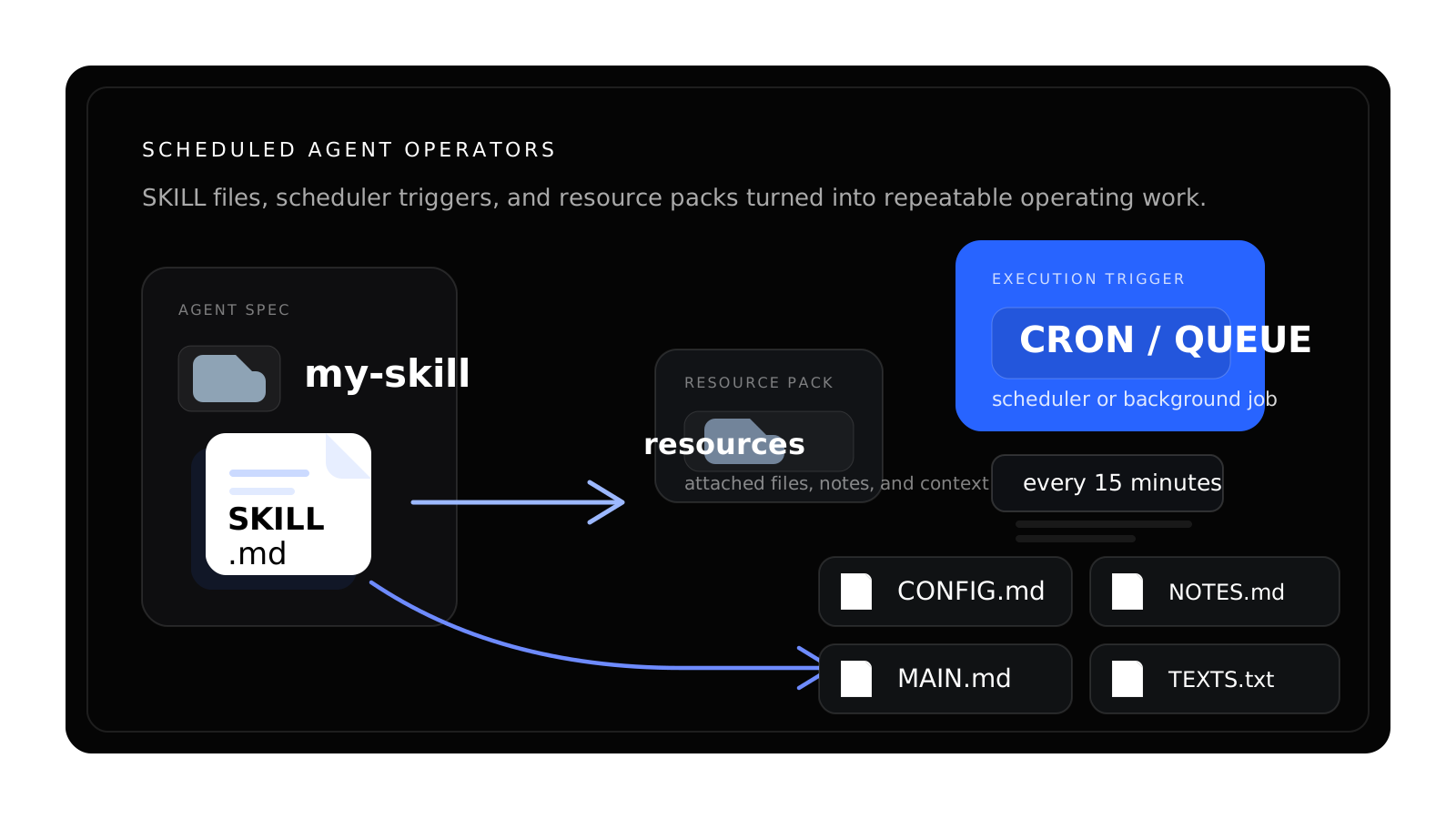
That is where a SKILLS.md file becomes useful. It can define the role, responsibilities, workflow, allowed tools, escalation rules, output format, and success criteria for one operator. In practice, that means you are not deploying a vague assistant. You are deploying a scoped worker.
The strongest pattern is not one all-purpose agent. It is a small set of specialized operators attached to real business workflows. One agent reviews inbound leads every fifteen minutes. Another compiles a morning market brief at seven o'clock. Another drafts content from transcripts twice a week. Another checks operational systems every night for duplicates, stale tasks, or broken handoffs.
This is also where scheduler design matters. Lightweight repeatable tasks can run on cron. Longer or heavier tasks should move into queue-backed jobs or background execution so they do not block the rest of the system. OpenAI's background execution guidance and Anthropic's guidance on clear prompting and tool-scoped agents both point in the same direction: explicit instructions, durable job handling, and limited role scope outperform vague autonomy.
A useful operator needs more than a prompt. It needs guardrails. The instruction file should state what the agent may do, what it may never do, when human review is required, and what counts as a successful output. High-risk actions such as publishing, legal changes, pricing updates, and external communication should not happen without review.
The important business shift is this: the goal is not to replace a whole employee with a chatbot. The goal is to remove specific categories of drag. Research collection, qualification, status reporting, tagging, summarization, and first-draft preparation are all better candidates than broad strategic ownership.
That is why the best agent systems look more like an operations layer than a digital coworker fantasy. Each operator has one lane. Each lane has a schedule or trigger. Each output is logged. Each exception is routed to a person. That is how the workload actually drops without trust collapsing.
The companies that benefit most from this are not the ones chasing the most autonomous demo. They are the ones willing to define the workflow, write the rules, and measure the result. When SKILLS.md files are used that way, they stop being documentation and start becoming infrastructure.